Quick Answer: The documents required for medical tourism in India include a valid passport, medical visa, hospital invitation letter, medical records, diagnostic reports, and proof of funds. International patients should also carry their insurance documents, previous prescriptions, and copies of all important papers. Having everything ready before you travel makes your entire treatment journey smooth and stress-free.
It is difficult to plan medical treatment in foreign countries due to many issues related to hospitals, doctors, flights, accommodations, etc. But one thing that patients normally realize at the last moment is their documents.
Even a single missing important document could hold up your medical treatment, visa or create unnecessary problems at the airport and hospital. This is precisely the reason why it is very necessary to be prepared well in advance. We have prepared an easy to use guide on all the documents required for your medical treatment in India. Now get started!
Why Do International Patients Need These Documents?
When you travel to India for medical treatment, you are entering a foreign country with a specific purpose. Indian authorities, hospitals, and visa offices need to verify who you are, why you are coming, and how you will manage your treatment and expenses.
Without the right documents, you may face these problems -
- Your medical visa application can get rejected
- Hospital admission can get delayed
- Your treatment timeline can get disrupted
- You may face issues at immigration on arrival
- Insurance claims can get complicated without proper paperwork
Having all your documents ready not only protects you - it also helps your doctors understand your full medical history and give you the best possible treatment from day one.
Also Read: What Is Medical Tourism and How Does It Work?
Documents Required for Medical Treatment in India: Complete Checklist by Category
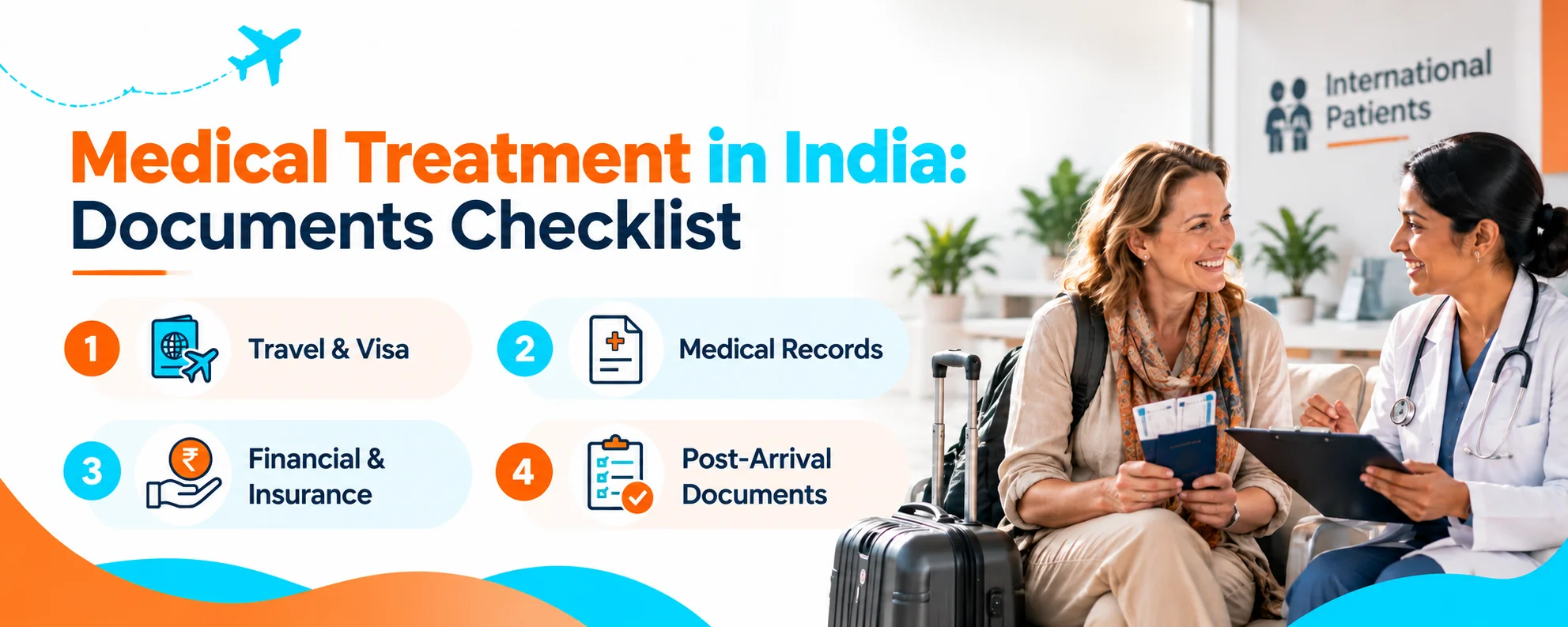
Here is your complete checklist of all documents required for medical treatment in India - organized by category so you can prepare everything step by step without missing anything.
1. Travel and Visa Documents
Before you even board your flight to India, your travel and visa documents must be completely ready. These are the first things immigration officers will check when you arrive.
- Valid Passport - Your passport must be valid for at least 6 months from your planned travel date to India.
- Medical Visa / e-Medical Visa - You must apply for a Medical Visa or e-Medical Visa specifically. A tourist visa is not accepted for medical treatment in India.
- Medical Attendant Visa / e-Medical Attendant Visa - Family members accompanying you need a separate Medical Attendant Visa. Up to 2 attendants are allowed per patient.
- Hospital Invitation/Appointment Letter - This official letter from your Indian hospital confirms your treatment. It is required when applying for your medical visa.
- Return or Onward Travel Ticket and Travel Details - Carry proof of your return flight or onward travel plans. Immigration officers may ask for this at the border.
- Passport-Sized Photographs - Carry at least 4 to 6 recent passport-sized photographs. You will need them for visa forms and hospital registration.
Your travel and visa documents are the foundation of your entire medical journey to India. Make sure every document is valid, complete and ready before you apply for your visa.
2. Medical Records
Your medical records are just as important as your visa. Indian doctors need your complete medical history to understand your condition and plan your treatment correctly from the very first consultation.
- Doctor's Referral Letter or Medical Summary - Ask your home doctor to write a detailed referral letter explaining your current condition and reason for seeking treatment in India.
- Diagnostic Reports (MRI, CT Scans, X-Rays, Blood Tests, etc.) - Carry all your recent diagnostic reports. Indian doctors will review these before your first consultation to save time.
- Previous Surgery and Treatment Records - If you had any surgeries or treatments before, carry those complete records. This helps Indian doctors avoid repeating unnecessary tests.
- Discharge Summaries - If you were ever admitted to a hospital before, carry your discharge summaries. They give doctors a clear picture of your past medical history.
- Current Medical Prescriptions - Carry all prescriptions your doctor has given you recently. Indian doctors need to know what medications you are currently taking.
- Medication List - Write down every medicine you take daily - name, dosage and timing. This is very important especially if you take multiple medicines every day.
- Vaccination Certificates (If Applicable) - Some countries require proof of certain vaccinations before travel. Carry your vaccination certificates just in case they are needed at immigration or hospital.
Your medical records tell the complete story of your health. The more detailed and organised your records are, the better and faster your treatment will be in India.
3. Financial and Insurance Documents
Travelling for medical treatment involves significant expenses. Indian hospitals and visa authorities may ask for proof that you can financially manage your treatment and stay in India.
- Recent Bank Statements or Proof of Funds (If Required) - Carry your last 3 months bank statements showing you have enough funds to cover your treatment and stay.
- International Health Insurance Card - If you have international health insurance, carry your insurance card. Some Indian hospitals accept direct insurance billing which saves you money upfront.
- Insurance Guarantee of Payment (GOP) Letter (If Applicable) - If your insurance company has agreed to pay the hospital directly, carry this GOP letter. It speeds up your admission process significantly.
- Treatment Cost Estimate - Your Indian hospital or a medical tourism company in india will give you a cost estimate. Carry this document - it helps with insurance claims and visa applications.
- Sponsorship Letter (If Applicable) - If someone else is paying for your treatment, carry a sponsorship letter from them along with their ID proof and bank statement.
- Payment or Insurance Pre-Authorization Documents (If Applicable) - If your insurance requires pre-authorization before treatment, make sure you have this document ready before you leave your home country.
Having your financial and insurance documents in order protects you from unexpected payment issues during your treatment and makes your entire stay in India much smoother.
4. Administrative and Post-Arrival Documents
Once you arrive in India, there are a few important administrative steps to complete. Being prepared with these documents will help you settle in quickly and focus entirely on your treatment.
- FRRO/FRO Registration (If Applicable) - If your medical visa stay exceeds 180 days, you must register with the Foreigners Regional Registration Office within 14 days of arrival in India.
- Local Accommodation Booking/Vouchers - Carry your hotel or guest house booking confirmation. Immigration officers may ask for your accommodation details on arrival at the airport.
- Government-Issued ID Proof of Attendants - Every family member or attendant travelling with you must carry their own government-issued ID proof along with their Medical Attendant Visa.
- Emergency Contact Information - Keep a written list of emergency contacts - your doctor back home, your Indian hospital contact, your medical tourism company, and a trusted family member.
- Copies of Passport, Visa, and Medical Documents - Always carry photocopies of every important document separately. If originals are lost or stolen, copies will help you recover faster.
Keep all your administrative documents in one separate folder. This makes post-arrival formalities quick and easy so you can focus completely on your health and recovery.
Also Read: Benefits of Choosing a Medical Tourism Company in India
How Should You Organize Your Medical Documents?
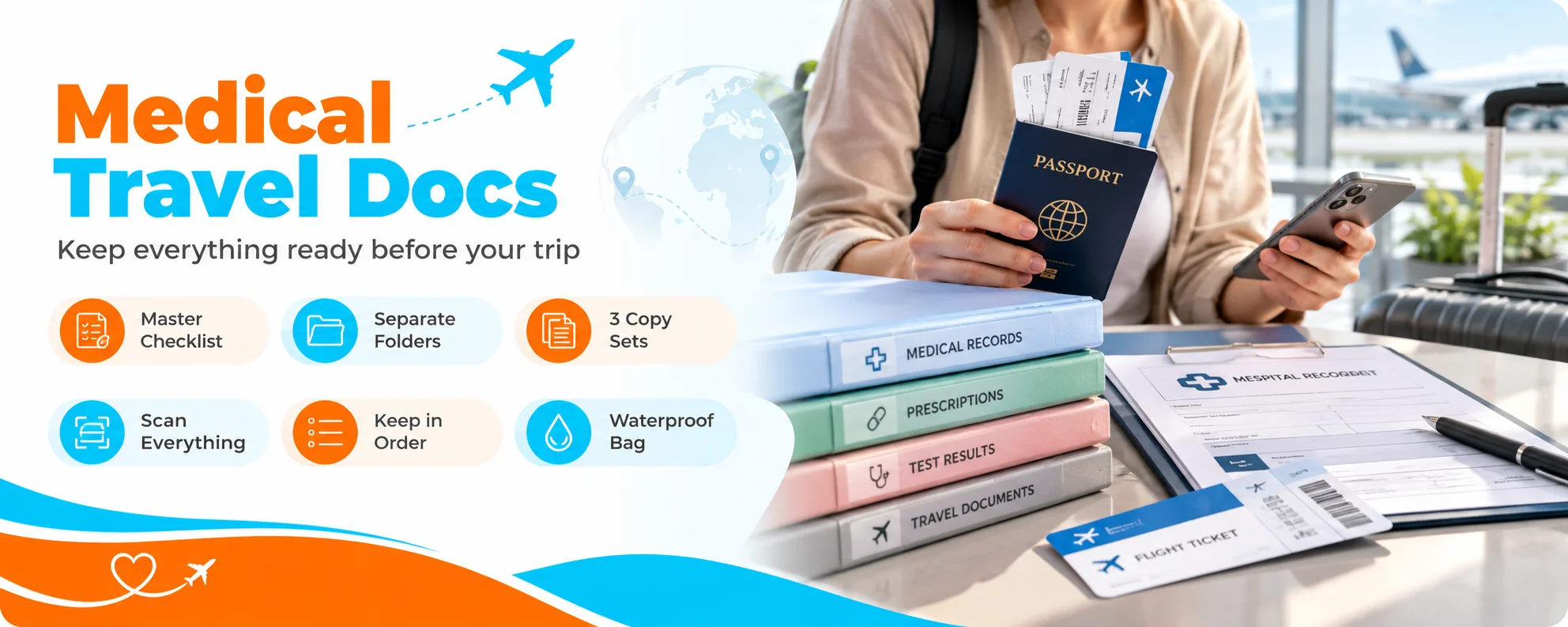
Organizing your documents properly before you travel can save you a lot of stress at the airport, visa office, and hospital.
Here is the simplest way to do it -
- Make a master checklist - write down every document from this blog and tick each one as you collect it
- Use separate folders - keep travel documents, medical records, and financial papers in different colour-coded folders for easy access
- Make 3 sets of copies - keep one set with you, one with your attendant, and one stored safely in your email or cloud storage
- Scan everything digitally - save scanned copies of all documents on your phone and email them to yourself before you travel
- Arrange documents in order - keep visa and passport on top, followed by hospital letter, then medical records so you can access them quickly
- Use a waterproof document bag - protect all your original documents in a waterproof bag especially during travel
Being organised with your documents gives you confidence and peace of mind throughout your entire medical journey in India.
Common Mistakes to Avoid When Preparing Documents for Medical Treatment in India
Many international patients make simple but costly mistakes when preparing their documents. Here is what you must avoid -
- Applying for a tourist visa instead of a medical visa
- Carrying expired passport or documents with less than 6 months validity
- Not getting the hospital invitation letter before applying for visa
- Forgetting to carry original diagnostic reports and only bringing photos on phone
- Not informing insurance company before travelling for treatment
- Leaving medication list and prescription at home
- Not carrying enough passport-sized photographs
- Forgetting to make photocopies of all important documents
- Not registering with FRRO when stay exceeds 180 days
- Carrying documents in different bags without any proper organisation
How Can Life Rx Healthcare Help International Patients?
At Life Rx Healthcare, we guide you through every step - from collecting your documents to getting your medical visa and hospital appointment confirmed. We make sure you arrive in India fully prepared and stress-free.
Ready to start your treatment journey? Contact Life Rx Healthcare today - we will handle everything for you.
Conclusion
Coming to India for medical treatment is one of the most important decisions of your life. And the last thing you want is to feel stressed or unprepared when you arrive. Having all your documents ready and organised before you travel makes everything so much easier - from clearing immigration to getting admitted to the hospital on the very first day.
We hope this complete guide on documents required for medical treatment in India has given you the clarity and confidence you needed. Every document on this list has a purpose and plays an important role in making your treatment journey smooth and successful. And if you ever feel confused or need help with any part of the process - Life Rx Healthcare is always here to guide you every step of the way.
Frequently Asked Questions
Q.1 What documents are required for a medical visa in India?
You need a valid passport, completed visa application form, hospital invitation letter from an Indian hospital, recent passport photographs, and proof of funds. Some embassies may also ask for your diagnostic reports or doctor's referral letter depending on your home country's requirements.
Q.2 Do I need a hospital invitation letter for an Indian medical visa?
Yes, a hospital invitation letter is required for an Indian medical visa. This letter must come from a recognized hospital in India confirming your appointment and treatment details. Life Rx Healthcare can arrange this letter for you quickly and officially.
Q.3 Can a family member accompany me for medical treatment in India?
Yes. India allows up to 2 family members or attendants to accompany a medical patient. They must apply for a Medical Attendant Visa separately. Life Rx Healthcare assists with attendant visa documentation along with the patient's visa application.
Q.4 Do I need to carry my previous medical reports?
Yes, absolutely. Your previous medical reports, diagnostic scans, discharge summaries and prescriptions are very important. Indian doctors need your complete medical history to plan the right treatment for you from the very first consultation without wasting any time.
Q.5 Do international patients need health insurance for treatment in India?
Health insurance is not mandatory but it is strongly recommended. Many top Indian hospitals accept international insurance. Having insurance can significantly reduce your out-of-pocket expenses. Always inform your insurance company before travelling and carry your insurance card and GOP letter if applicable.
Q.6 Is FRRO registration required for medical visa holders?
FRRO registration is required only if your stay in India exceeds 180 days on a medical visa. You must register with the Foreigners Regional Registration Office within 14 days of arrival. Life Rx Healthcare team can guide you through this process if needed.