
 new.webp)
Medical tourism is one of the fastest-growing sectors in global healthcare. But for a first-time international patient, navigating treatment abroad alone is complex and risky. This guide explains what a medical tourism facilitator does, why global health research confirms you need one — and how LifeRxHealthcare delivers this support end-to-end.
Medical tourism — the practice of travelling to another country to receive medical treatment — has grown from a niche behaviour into one of the world's most significant healthcare trends. And the numbers make this unmistakably clear.
According to Statista, the global medical tourism market was valued at USD 47 billion in 2024 and is projected to more than double — reaching over USD 111 billion by 2029. Research from Grand View Researchputs the 2025 figure at USD 34–43 billion, with a compound annual growth rate of around 14–21% through to 2034–2035.
Understanding why patients choose medical tourism is essential to understanding what a facilitator does. Research consistently identifies the same core drivers — and they have only intensified over recent years.
Cost Savings: The single largest driver. Treatment costs abroad are typically 30–90% lower than in the USA, UK, or Australia. For uninsured or underinsured patients, this is not a preference — it is a necessity.
Long Waiting Lists:In countries with public health systems, patients can wait 12–24 months for non-emergency procedures. Medical tourism destinations offer near-immediate scheduling for most treatments.
Access to Specialised Care: Some treatments — advanced oncology, robotic surgery, specific transplant procedures — are unavailable or not approved in a patient's home country. India's top hospitals offer these at world-class standards.
Quality of Healthcare:Around 50% of medical tourists choose destinations specifically because of access to high-quality healthcare services — not just lower prices. India's JCI-accredited hospitals meet US and European quality standards.
No or Inadequate Insurance:According to the Commonwealth Fund, 43% of working-age adults in the USA were inadequately insured in 2022. For these patients, medical travel to affordable destinations is the most viable path to care.
A 2024 study published in ScienceDirect confirmed that medical travel facilitators (MTFs) play a crucial role in the success of medical tourism by "acting as a bridge between patients and healthcare providers" — and that the rapid growth of the industry has made the facilitator role more essential than ever.
A medical tourism facilitator(MTF) is a company or individual that acts as the intermediary between an international patient seeking healthcare and the hospitals, doctors, and support services in the destination country.
Research published in PMC (National Library of Medicine) defines the MTF role as follows: facilitators "play a significant role as moderator in engaging between prospective patients in one country and medical facilities elsewhere around the world," coordinating care quality, managing logistics, and addressing health risks on behalf of the patient.
The role of the facilitator is distinct from both the hospital and the travel agent. The facilitator operates in the space between — providing clinical navigation, logistical support, cost transparency, cultural guidance, and post-treatment continuity that neither hospitals nor travel agencies are built to deliver.
Academic research and industry studies identify a clear set of competencies and responsibilities that define a high-quality medical tourism facilitator. A 2024 study in ScienceDirect — based on interviews with 30 international healthcare experts — categorised facilitator competencies into clinical navigation, logistical coordination, patient advocacy, cultural mediation, and post-care continuity.
A facilitator reviews the patient's medical records, diagnosis, and treatment history, and matches them with the most appropriate specialist and hospital — based on expertise, outcomes data, and accreditation. This is not random allocation. It is informed matching based on years of clinical network knowledge.
.webp)
One of the most common patient grievances in medical tourism is unexpected costs. A quality facilitator contacts the hospital directly, obtains a detailed all-inclusive quote — procedure, diagnostics, medications, hospital stay, follow-up — and presents this to the patient before any travel commitment is made.
Before the patient boards a plane, the facilitator arranges a video consultation between the patient and their assigned specialist. This gives the patient confidence, allows the doctor to review the case in detail, and ensures there are no surprises on arrival. Research confirms this step significantly increases patient satisfaction and reduces anxiety.

India has a specific Medical Visa category — different from a tourist visa — with its own documentation requirements, including a hospital invitation letter. The facilitator provides this letter, guides the patient through the full application, and supports family members with attendant visas. India's e-medical visa facility now covers nationals of 171 countries.
Airport pickup, hotel near the hospital, local transport during the stay — the facilitator arranges all of this in advance so the patient arrives into a prepared environment, not an unfamiliar city. This is especially critical for patients who are already unwell when they arrive.

Throughout the hospital stay, the patient has a single named contact available around the clock. This person acts as the patient's advocate — communicating with doctors, resolving queries, handling paperwork, and ensuring the patient always has a direct voice in their own care. The Medical Tourism Magazine identifies this as one of the most critical differentiators of quality facilitators.[Medical Tourism Magazine]
When the patient is ready to leave, the facilitator ensures all medical records, discharge summaries, imaging reports, and prescription instructions are compiled in English. This is essential for the patient's home country doctors to continue care without any gaps.

Recovery does not end at the airport. A quality facilitator coordinates scheduled remote consultations between the patient and their treating specialist — at agreed intervals over the weeks and months following treatment. This is one of the most under-served aspects of medical tourism, and one of the clearest differentiators between facilitators that genuinely care for patients and those that do not.
LifeRxHealthcare is a New Delhi-based medical tourism company with over 20 years of dedicated experience facilitating international patient journeys to India. It is partnered with India's top hospital groups — Apollo, Fortis, Max, Medanta, Manipal, Narayana Health, Wockhardt, and more — all of which hold JCI or NABH international accreditation.
The company has helped more than 15,000 international patients from over 100 countries across Africa, the Middle East, Central Asia, Europe, and South Asia access world-class medical treatment in India. It provides access to a network of over 50 partner hospital groups and more than 50,000 specialist doctors.
Life Rx Healthcare delivers every one of the 8 core facilitator roles described above — with zero facilitation fees to the patient, a 24-hour treatment plan turnaround, complete cost transparency, and post-treatment follow-up care extending to 6 months after the patient returns home.
For treatments, Life Rx Healthcare facilitates access across the full spectrum of major medical specialities — cardiac surgery and angioplasty, cancer treatment (chemotherapy, targeted therapy, robotic surgical oncology), organ transplants (kidney, liver, bone marrow), orthopaedic procedures (knee and hip replacement, spine surgery), neurology and brain surgery, IVF and fertility treatments, bariatric surgery, dermatology and cosmetic procedures, ophthalmology, dental implants, and hair restoration.
The patient source countries that rely most on us include nations from Sub-Saharan Africa, the Gulf Cooperation Council (GCC), Central Asian republics, South Asia, and Eastern Europe — all regions where either the cost of treatment in local healthcare systems is prohibitive, or where specialist capacity is insufficient to meet demand.
Also Read: How to Choose the Best Medical Tourism Company in India
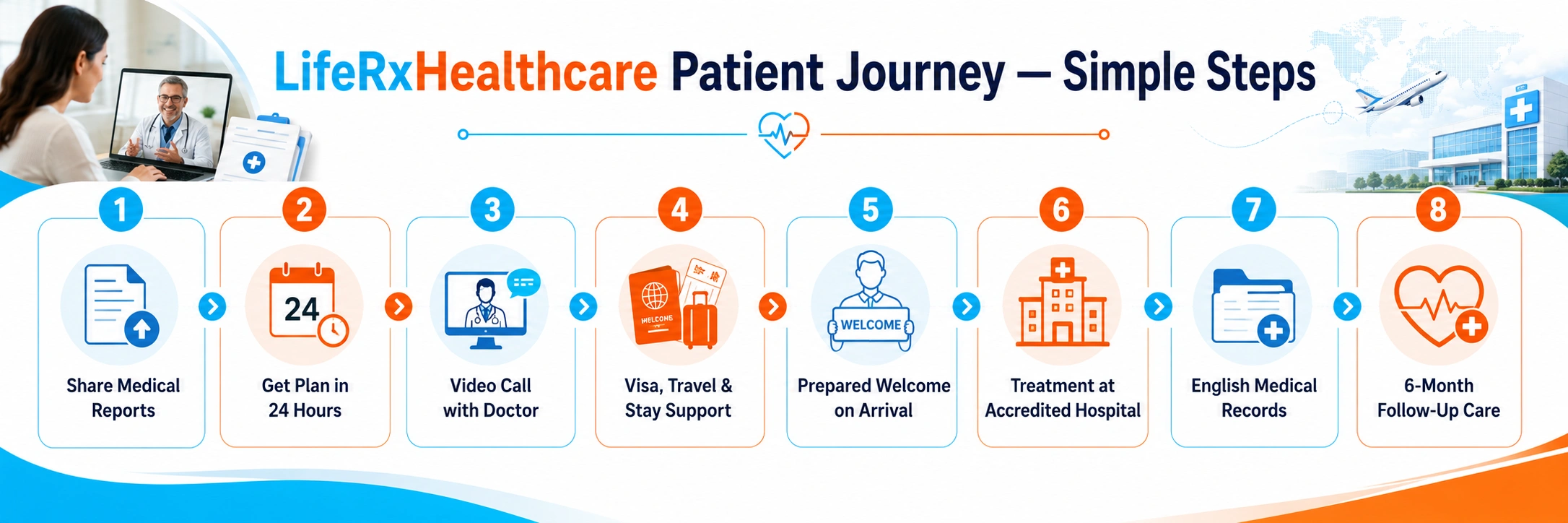
For a patient approaching Life Rx Healthcarefor the first time, the journey follows a clear, structured process. There are no hidden steps and no unexpected requirements.
Follow-Up Care for 6 Months After You Leave:Remote consultations with your specialist are coordinated at 2 weeks, 6 weeks, 3 months, and 6 months post-treatment — from wherever you are in the world.